
What your dentist can see during an exam tells only part of the story. Decay developing between teeth, bone loss progressing beneath the gumline, a crack forming inside a tooth that looks perfectly intact from the outside — none of these conditions announce themselves visually until they have already done significant damage. The ability to find them early is not a matter of looking harder. It is a matter of looking differently.
Gardens Dentistry Palm Beach uses advanced digital X-rays in Palm Beach Gardens, FL, as a core component of every diagnostic visit, providing immediate, high-resolution images that give us a complete picture of what is happening inside and beneath your teeth. Dr. Dalia believes deeply in technology that makes diagnosis faster, more accurate, and more comfortable, and digital radiography is one of the clearest examples of that philosophy in daily practice.
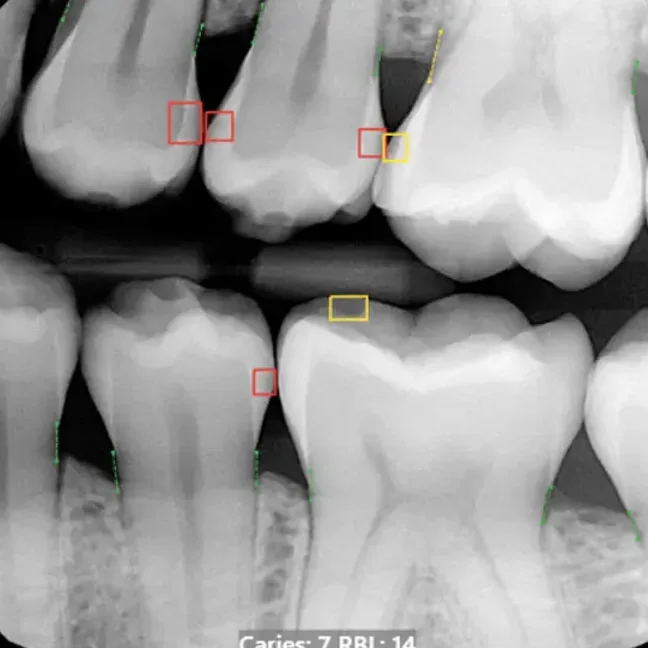
The oral cavity is largely opaque. Enamel, dentin, bone, and root structure exist in a three-dimensional space where only the outermost surfaces are directly visible, and the conditions most likely to cause long-term damage tend to originate precisely where no light reaches. Digital X-rays allow us to see through those surfaces safely and accurately, revealing information that fundamentally changes how we understand each patient’s oral health status.
The conditions we identify through digital imaging include interproximal decay, the cavities that form between teeth where toothbrush bristles cannot reach, and where clinical probing provides limited information. They include early-stage bone loss around teeth or implants, which appears on X-rays long before it produces symptoms or changes in clinical measurements. They include widened periodontal ligament spaces that indicate stress on a tooth, root tip abnormalities, cysts developing within the jawbone, and impacted or malpositioned teeth that would otherwise go undetected until they caused pain or adjacent tooth damage.
The transition from film-based X-rays to digital sensors represents one of the most meaningful upgrades in everyday dental practice over the past two decades. The difference is not subtle, and it affects patients in ways that matter.
Digital sensors require substantially less radiation to produce a diagnostic image than conventional film. According to the American Dental Association, radiation doses in dental imaging are much lower now than in the past due to advances in technology, and digital systems are a primary reason for that improvement. For patients who are understandably cautious about any radiation exposure, digital X-rays represent the most conservative approach available in clinical dental practice.
Film required chemical processing that introduced time delays and variables that affected image quality. Digital sensors transmit images to a chairside monitor within seconds of exposure. We can enlarge specific areas, adjust contrast, and review findings together with you in real time during the same appointment. There is no waiting, no guessing, and no returning for a repeat image because of a processing issue.
Film-based systems required chemical developers and fixers, physical storage of film jackets, and eventual disposal of hazardous materials. Digital imaging eliminates all of that. Images are stored electronically, accessible instantly for comparison across appointments, and transferable to specialists or other providers without degradation in quality.
Digital imaging is not a single tool with a single purpose. At Gardens Dentistry Palm Beach, we use different types of digital X-rays depending on what we are evaluating and why.
Bitewing X-rays focus on the crowns of upper and lower back teeth and the supporting bone between them, making them ideal for detecting interproximal decay and monitoring bone levels in patients with a history of gum disease. Periapical images capture an entire tooth from crown to root tip, giving us a complete view of root structure, surrounding bone, and any pathology developing at the apex. Full-mouth series provide comprehensive baseline documentation for new patients and those undergoing complex treatment planning. Panoramic imaging gives a broad overview of the entire jaw, including structures relevant to implant planning, impacted teeth, and sinus evaluation.
Each decision about which images to take is made based on your clinical findings, health history, and individual risk profile, not a fixed protocol. Our approach to imaging aligns with the ADA’s recommendation that X-rays be ordered only when they provide diagnostic information necessary to support treatment decisions.
Digital X-rays work in concert with every other aspect of the preventive and diagnostic services we provide. The images taken during your diagnostic and prevention appointment establish a baseline that makes change visible over time, transforming individual snapshots into a longitudinal record of your oral health. Findings from imaging directly inform our dental cleaning and hygiene protocols, our dental sealant recommendations, and our periodontal monitoring approach. When restorative work is needed, the precision of our digital imaging supports the accuracy of treatments like our same-day crown restorations from planning through placement.
Great dental care begins with accurate information, and accurate information begins with the right imaging technology used at the right time. At Gardens Dentistry Palm Beach, our team pairs digital radiography with a thorough clinical process and a genuine commitment to sharing what we find with you in a way that is clear, honest, and useful. We welcome patients from Palm Beach Gardens, Jupiter, and North Palm Beach who want dental care built on a foundation of precision.
We accept most insurance plans and offer flexible financing through CareCredit and Cherry, along with an in-house membership plan for patients without traditional dental coverage. Contact Gardens Dentistry Palm Beach today to schedule your next appointment and experience the difference that advanced imaging makes in the quality of your care.
Yes. Digital sensors require substantially less radiation than conventional film X-rays. According to the American Dental Association, advances in technology — including digital imaging — have significantly reduced radiation doses in dental care.
The frequency depends on your clinical findings, health history, and individual risk profile. X-rays are ordered only when they provide diagnostic information necessary to support treatment decisions — not on a fixed schedule regardless of need.
Yes. Our in-house membership plan includes a full set of radiographs each year — no insurance required, no deductibles, and no claim forms.
"*" indicates required fields